Feedback funnels · The storyboard’s feedback feature · Sep 2026
One funnel, two vocabularies.
Storyboard members can file a note against any drawn panel. What happens to that note is the feature on this page: it is captured with the frame and the exact build it points at, it crosses one gate, the site proposes a route and a person rules, and the panel is rebuilt from the source it landed on. Drawn beside a product team’s customer-feedback operation, it is the same funnel. Drag the diagram and only the nouns change.
Gold · a product team
A customer reports a breakdown. Captured with what they were doing and the version they were on. The system sorts, a person prioritises against motivation, context, experience and priority, and the fix ships as a new version.
Blue · Red Eagle’s storyboard
A member writes a note. Captured with the frame and the panel build they saw. The site triages, the author rules, the note lands on the source file beneath the panel, and the panel is rebuilt to a new hash.
The apparatus
Here it is, running.
Every note enters carrying the build it was written against, nothing generative may assert a fact, and questions of fact end in a human ruling. Gold, on the left, is a product team’s customer feedback. Blue, on the right, is a storyboard member’s note on Red Eagle, where a confident error ships in public.
Turn your phone sideways to read the diagram.
1040px wide · pans with a finger · the slider wipes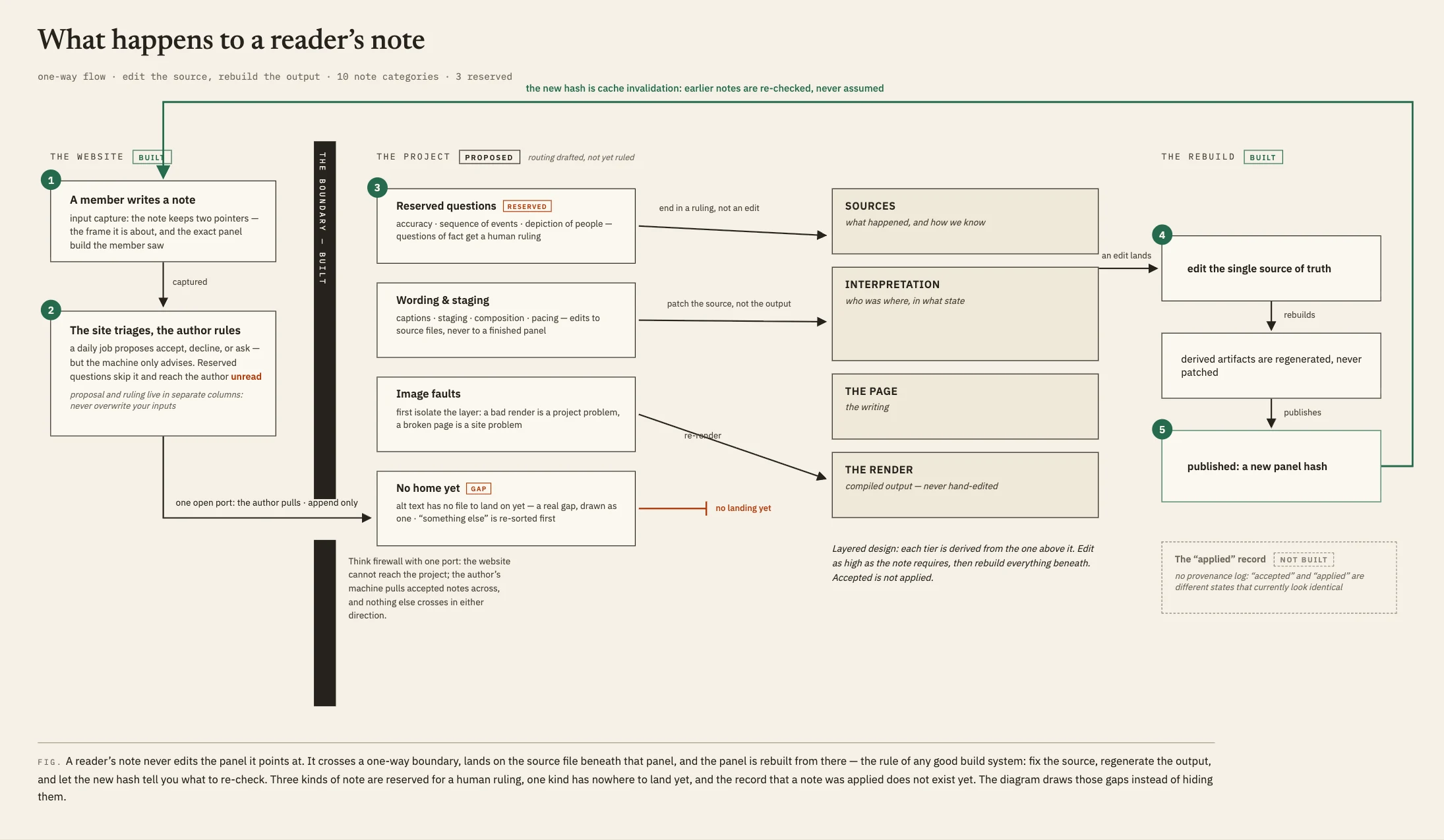
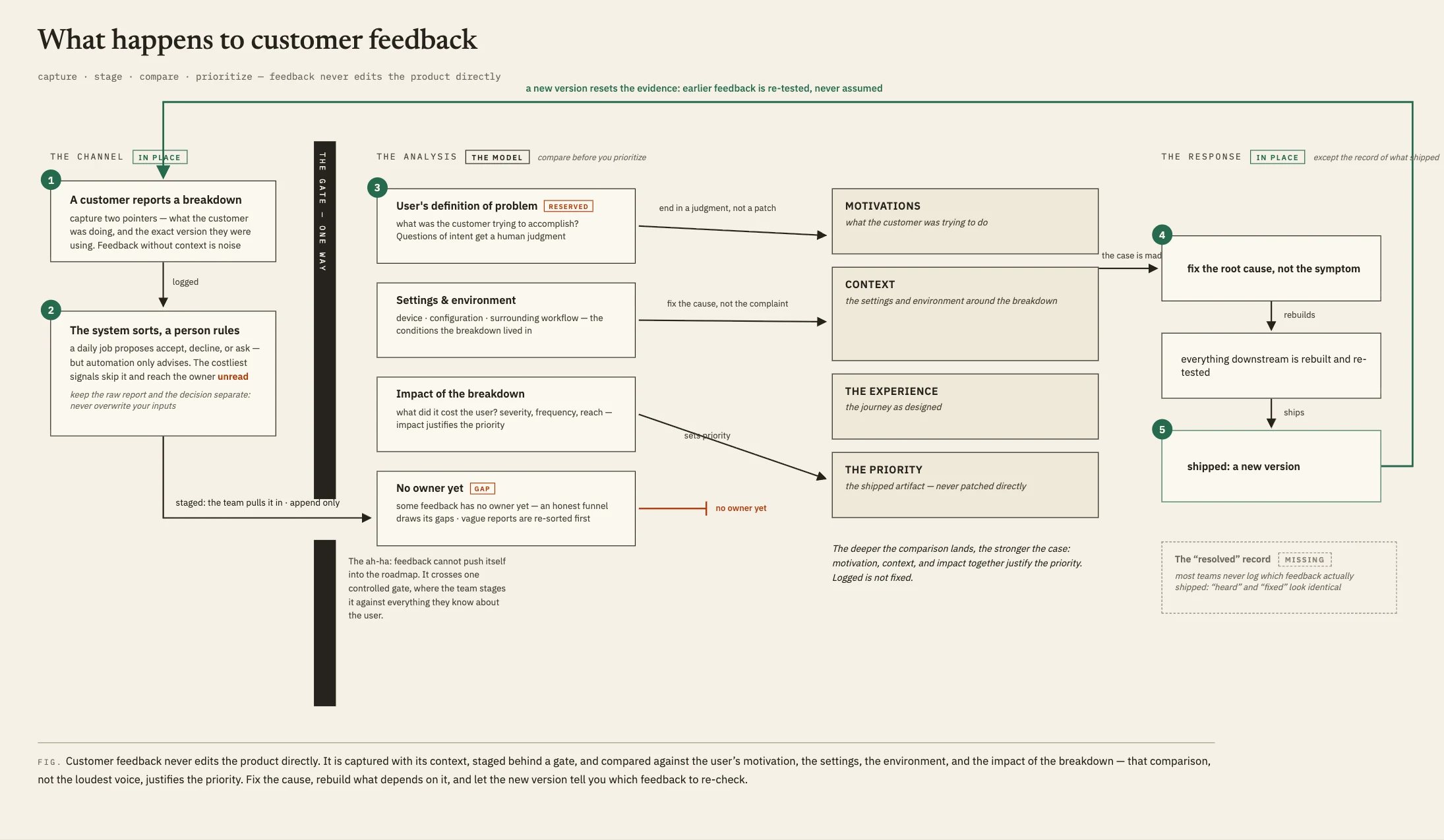
Fig. — one route, two vocabularies. Expand to read it at full size. Scroll the diagram sideways to read it. Product version · history version
A diagram is a promise. The storyboard is the receipt. The blue half of this map is running: members file notes against drawn panels, each note keeps the frame and the exact panel build it points at, the site proposes a route and the author rules. The quality-control section lists which pieces are built, which are proposed, and the one that is not.
Request access to the storyboardThenOnboarding opens the live view: real notes moving through the gate and rulings landing on source files. The gold half is the same funnel with a product team’s nouns, which is the point of drawing them as one diagram.
The diagram’s built, proposed and not-built markings correspond to live entries in the project repository. Source IP: Aaron Zeanah, “The End of the Alabama Frontier,” International Journal of Interdisciplinary Social Sciences, Vol. 6, No. 4 (2012).