Red Eagle · Project hub · 15 Sep 2026 · Season One
Breathing life into old stories.
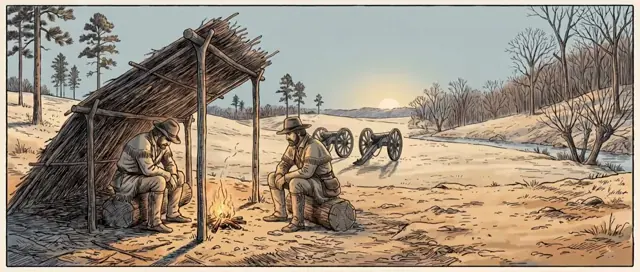 The first moving shot
Fort Strother, December 1813. Eight seconds, out of two still drawings.
The first moving shot
Fort Strother, December 1813. Eight seconds, out of two still drawings.
11:S5 · kling-v3 · 8s · 21:9 · interpolated between two authored plates, not prompted as video. This is the second pass: in the first the walking man lost his hat on the way out, because the end plate he was arriving at had no hat on it. The fix was to the drawing. How the pair was made →
I published a history paper in 2012 on the Creek leader some called Red Eagle. Then I spent fourteen years building a career in technology.
The paper is good but as with academic work, almost nobody reads it. That reminded me: most of what we actually know about our own history never leaves the university, or we learn it from Hollywood. So I picked mine back up, brought along everything I had learned since, and started turning it into a film. AI draws the frames based on the detailed research that’s available on the record.
If you’ve built software, you understand the next gap: requirements documentation. A generation pipeline that has to clear rigorous historical accuracy requirements is the same governance problem every AI product has: sources, constraints, evaluation criteria, and a person who signs off before anything counts.
So I am showing the work rather than describing it. Open any claim on this site and follow it to the record underneath, or to the note that explains which library to find it in.
Source materialAaron Zeanah, The End of the Alabama Frontier: Weatherford’s Perspective, International Journal of Interdisciplinary Social Sciences, Vol. 6, No. 4 (2012). The peer-reviewed research this project adapts. Buy the paper →
Interactive Exhibits
Both of these are running right now, and both take input from you. The storyboard is the film as it currently stands, beat by beat, with its gaps labelled. The ghost writer is the research agent that drafts Jackson’s side of a scene and refuses when the record will not carry it.
Exhibit A Gated
Storyboard
The screenplay cut into 221 beats and set against the art that actually exists. 55 are drawn. 57 are held until the consultation happens, 12 more because the software cannot yet work out who is in the scene, and 97 are simply not made yet. The page says which is which, beat by beat, instead of showing you only the finished ones.
Why it is gated182 of the 221 beats are flagged for consultation, because you cannot ask people about a depiction that does not exist yet. Access is by request, and I keep a record of who has it.
Why it mattersEverything above exists to produce this. Putting a gated, unfinished artifact in front of real reviewers with its gaps labelled beat by beat is shipping under constraint, not waiting for perfect.
Access the Storyboard →The feedback featureMembers file notes against drawn panels, and what happens to a note is drawn beside what a product team does with customer feedback: one funnel, two vocabularies. Drag the diagram →
Exhibit B
Our ghost writer: Andrew Jackson
A conversational agent built on 15,909 public-domain documents from the Papers of Andrew Jackson and the Library of Congress. Ask him about a scene and he answers in his own register, scoped to what he could know on that date. Speaking to a Creek listener, he answers in the third person, because the record does not entitle him to more.
Why it is hereIt refuses. A quotation no human has checked against the printed page is withheld, with the reason named. The refusal is the product, and it is the part that carries into the Jackson scenes.
Why it mattersThis is the only part of the project you can put your hands on, and it is where the governing rule becomes visible: he answers inside what the record supports and declines when it does not. Defining that boundary before shipping, rather than apologising for it after, is the work on any AI product with a compliance surface.
Meet Our Ghost Writer →The record
The artifacts the build left behind
Four reports on how the thing was actually made: how the work is governed, where the evidence comes from, what the checks caught, and what broke along the way. Each one shows how a rule got decided, what it caught, and what it cost to run.
Artifact 01
How it runs
Eight AI roles, each with one job and a written list of things it is not allowed to do. Work moves in one direction, up through four stages, and does not get handed back down. Each assignment says what that role is allowed to open, and each answer has to come back in a form I can check before it counts.
The rule that changed thingsOne agent finds the material. A different one reads it and decides. Writing that line down turned a problem I could not see into one I can catch. Five assignments have been pulled back before sending since.
Why it mattersEight roles with written limits is what makes the output repeatable instead of lucky. Separation of duties and stage gates are the ordinary controls of regulated delivery, applied to agents instead of engineers.
See how the work is run →Artifact 02
Research
Where the evidence comes from, and what shape it is in. Every claim carries a tag for how well it is sourced. And rather than argue about whether a story is true, I date it: I find the first time it appears in print. That usually settles it.
What that turned upEven the name most people know him by traces to an 1855 poem, and appears in no document from his lifetime. That one fact decides what the film can stage as history and what it has to stage as legend.
Why it mattersEverything downstream inherits these grades, so a weak source caught here never reaches a frame. Turning contested, uneven material into a rated and queryable base is the same job as making a company’s own records fit for a model to use.
Still writing this oneArtifact 03
Quality control
The checks that catch the work when it slips, and what they cost to run. A register tracks where every citation stands. A 75-point rubric scores each round, with 13 ways to fail outright. One of the AI roles is assigned to attack the work rather than help it. And two decisions end with a person rather than a score.
What it actually caughtThe attacking agent raised about 75 objections. Eight held up. Two were real defects nobody had caught. Loud, mostly wrong, and still worth running. The log keeps the cost next to the catch.
Why it mattersWithout this, every accuracy claim on the site is only a claim. Running an adversarial agent, scoring against a rubric, and publishing what each control cost beside what it caught is how you justify a QA budget to the person funding it.
See how the work gets checked →Artifact 04
What went wrong
Five failures with dates on them, what caused each one, and the check that came out of it. None of them were in the plan. Every one left something reusable behind, because a lesson you cannot hand to somebody else is a lesson you get to learn twice.
The one that still stingsAn AI role wrote up a 673-page book it had never been sent. Page numbers, transcriptions, an editor's note: all of it consistent, all of it invented. The check that came out of it compares answers against facts already on file, not against how certain the answer sounds.
Why it mattersFive failures with dates on them, each one the reason a control now exists. Publishing the incident rather than the polished outcome is what makes everything else on this page credible, and it is how a postmortem is supposed to end.
Read what went wrong →Contact
Aaron Zeanah
Product and customer strategist, and the historian whose research this adapts. Ten years running product operations in regulated, compliance-heavy places: Intercontinental Hotels Group, Coca-Cola, WarnerMedia / NBA Digital, FanDuel. Trained as a historian (B.A. History, Auburn; published 2012). I build product systems for work where you have to be able to show where everything came from.
Scan to open this hub
Source: Aaron Zeanah, “The End of the Alabama Frontier,” International Journal of Interdisciplinary Social Sciences, Vol. 6, No. 4 (2012). Register ids, decision numbers and audit-pass numbers match live entries in the project repository, checked against it on 26 Aug 2026. The Creek War involved the mass killing of real people, and their descendants are living communities today: the Poarch Band of Creek Indians and the Muscogee (Creek) Nation. Production is gated on consultation.