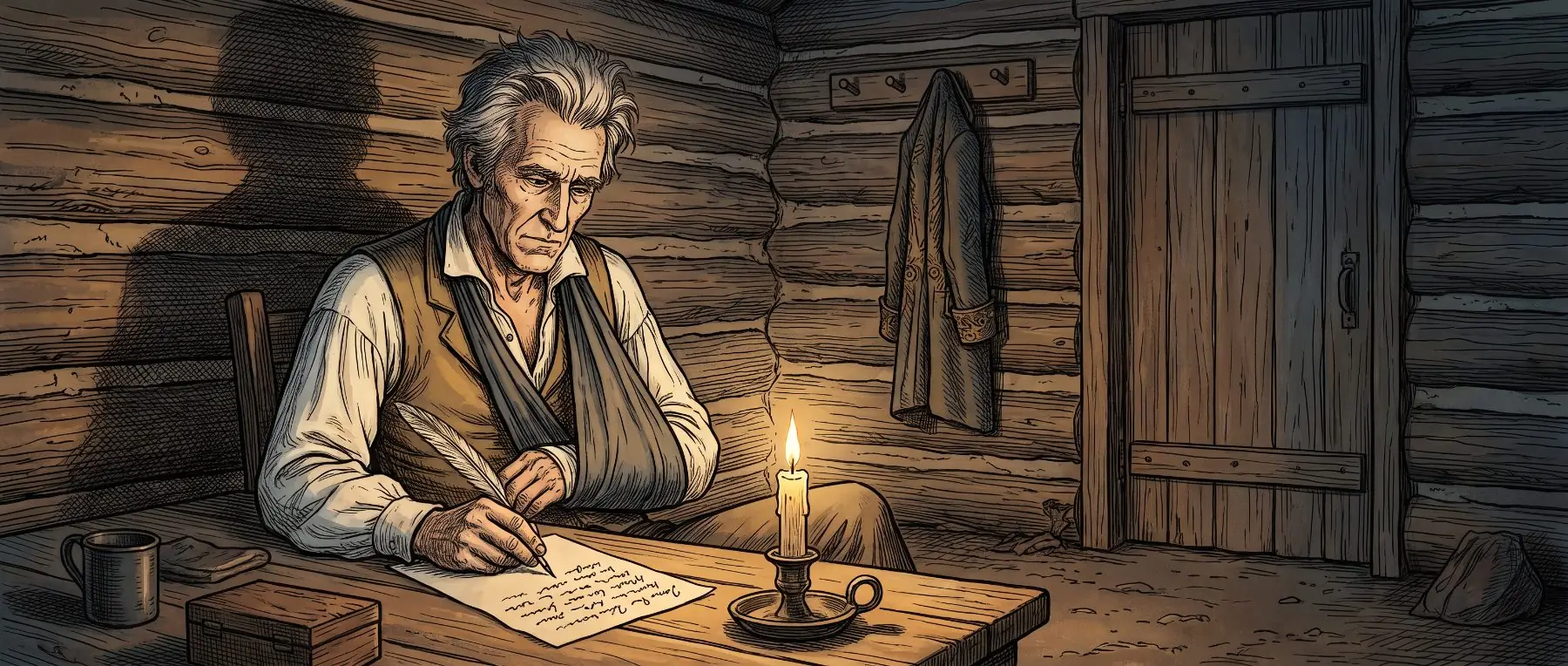
Correspondence desk · b. 1767 — d. 1845 — still answering mail
Andrew Jackson & his governance.
A conversational agent built on 15,909 public-domain documents from the Papers of Andrew Jackson and the Library of Congress. He answers in his own register, scoped to what he could know on the date of the scene you choose. The interesting part is not when it answers. It is when it declines, and tells you which check stopped it.
Ask Andrew Jackson
He answers only from his own surviving correspondence, scoped to what he could know on the date of the scene you pick. Every answer is checked before you see it. When the record does not support something, the system withholds the answer and tells you why. That refusal is the point of the build.
Built on the open-access Papers of Andrew Jackson and Library of Congress holdings: 15,909 documents, each carrying its volume and printed page. The model may paraphrase and cite; it may not quote anything a human has not checked against the printed page.
How he's kept honest
A dead man's perspective, brought back to life, and checked four ways before it reaches you.
Every response carries its verification strip. Nothing is taken on trust — including him.
01 · Date lock
Each scene fixes a date. He cannot answer from anything written after it, so he cannot know how the treaty was received or what removal became.
02 · Quotation gate
The model may paraphrase and cite. It may not put words in quotation marks unless a person has checked that span against the printed page. A quotation that exists in the register but has not been verified is withheld, and the reason names it.
03 · Claim check
Dates, quantities and names in the answer are verified against his papers before you see it. Anything unverifiable is flagged or blocks the answer entirely.
04 · Register
The listener determines how he is permitted to speak, including whether he speaks in the first person at all. The disposition in force is reported with every answer, so you can see which rule you are reading under rather than taking it on trust.
Two things at once, and they are the same build
A customer-experience instrument
Standing up a conversational agent on a real corpus is not hard once the dataset is in hand. Making one that refuses to answer, states the reason, and shows its working is a governance problem, and that is the part worth hiring for. Every response above carries its date lock, its register, a quotation gate and a claim check.
A storytelling instrument
Pointed at a motive in a specific setting, it produces dialogue that survives contact with the record. That is its role inside the writing flow of the Red Eagle screenplay project.
Scope
What this bot covers, and what it does not
The exhibit above answers from one man’s papers, 15,909 records, and that is the only documentary corpus in this project. Fifty-six characters speak in this screenplay. One of them has papers. The other fifty-five have none at all.
That is why there is one bot here and not fifty-six. A retrieval system for a character with no surviving record is a language model with a name on it, producing invention at speed. Fifty-six bots would be fifty-five confident voices with nothing behind them, and confidence without a record is the failure this project exists to price. The architecture is one engine, one corpus, and a declared rung on every line. A speaker with papers can claim the documented rungs. Everyone else is held to an interpretive floor and has to say so.
Two defects found in this component
A field borrowed for a second purpose is the expensive error. The field selecting each character’s grammatical register turned out to be the wardrobe axis, whose values are rules about bonnets and stays. A ruling against exactly that was already in the project documentation, fourteen days old, in a file the tool never read. The structural half is worse. Gating the characters at the center of the work removed the only field that identified them, so the field returned nothing for exactly the people who mattered most.
A measured zero needs a date on it. An evidence census reported that the subject at the center of this work has no surviving words. The corpus is one man’s papers, so the census had measured his correspondents rather than the historical record, and the project’s own acquisition queue already ranked the outstanding test for that subject as priority one. Coverage metrics read off the data you hold quietly become claims about the world.
The man at the desk (the living one)
Jackson answers the mail. Aaron built the room he answers it in.
Governed conversational products: scoping, refusal design, verification, and the discipline to withhold. If that is the problem on your desk, he also answers mail — rather faster than the General.
Built on the open-access Papers of Andrew Jackson and Library of Congress holdings: 15,909 documents, each carrying its volume and printed page. The corpus is public domain. Questions asked here are not project input and are not fed to the screenplay: the website marks every request as a public-web query so the writing pipeline can refuse it. Consultation with the Poarch Band of Creek Indians and the Muscogee (Creek) Nation has not taken place.