Case study · Image generation · 16 Sep 2026
Eight seconds of film, and the runs that earned them.
A still pipeline cannot make a moving shot. It needs two drawings of the same moment, a start and an end, that are the same place with one thing changed. Getting two frames to agree that closely took a week of single-image tests, three of which are below. The clip at the top is what they bought.
Unit 11, scene 5. Fort Strother, December 1813. Two men at a fire, and one of them gets up to go and find something to eat.
Run 53 · The first moving shot of the film
Eight seconds, 21:9, twenty-four frames a second, built from two still plates and nothing else. The camera is locked off and never moves, which is a setting that had to be forced: left to itself the model rewrites the instruction and invents a push-in.
The test is not whether it looks good. It is whether the clip begins on the plate the author drew and ends on the other one, because that is the only property that makes a shot editable into a film. Measured as a mean difference against each plate:
10.74
first frame against the start plate
11.36
last frame against the end plate
20.97
first frame against the wrong plate, as a control
Each end of the clip is about twice as close to its own plate as to the other one, so the shot lands where it was authored rather than somewhere the model preferred. The timing was obeyed too: the beat says the second man rises at four seconds, and at four seconds he is up. The drawing also survives the motion. Ink contour, hatching and flat colour are still there at eight seconds, which had only been measured to five.
Every picture starts as about five thousand characters of written instruction: the look, the landscape zone by zone, who is in it, what they are wearing, and a list of things not to draw. When one comes back wrong, the useful move is almost never to argue with the model. It is to change one thing in the instructions, pay for one more image, and see what moved. Three of those are below, and what matters is the sequence rather than the pictures: one fixed something the model was never being told, one tested a tidy theory and lost, and one changed the method for how a pair of frames gets made at all.
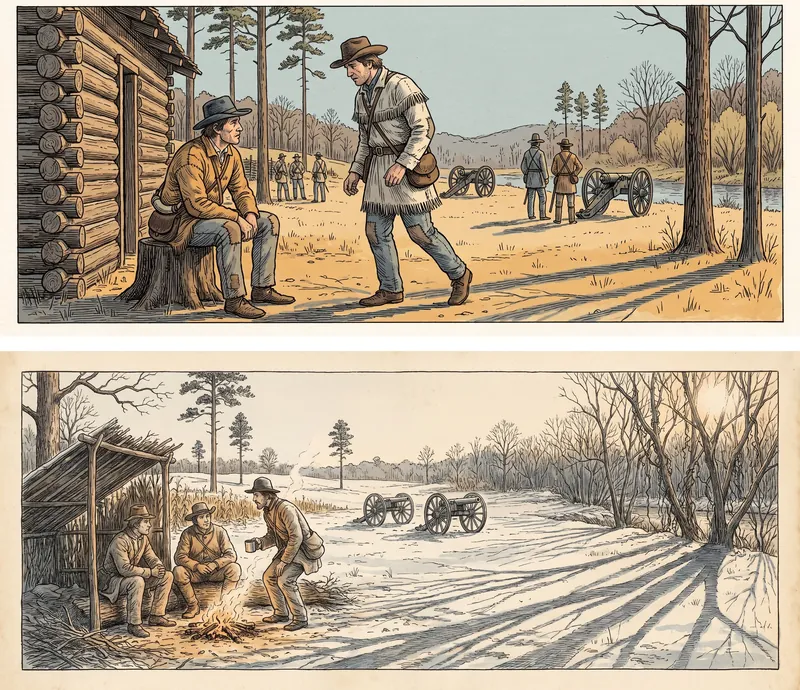
Run 46 · The ruling was written down. Nothing was reading it.
Winter camp at Fort Strother, December 1813: shelters of poles and brush, open on one side to a fire. That is ruled and printed on the scene’s set card, and the model had never seen it, so three frames running drew a log cabin (above). One injected sentence naming the objects fixed it (below).
The fix was plumbing, not wording. A script now writes each scene’s ruled objects into every prompt for that scene. Rulings that had never once reached a picture: 43 before, 37 after.
1 image · 40 cr
six rulings reached a frame for the first time
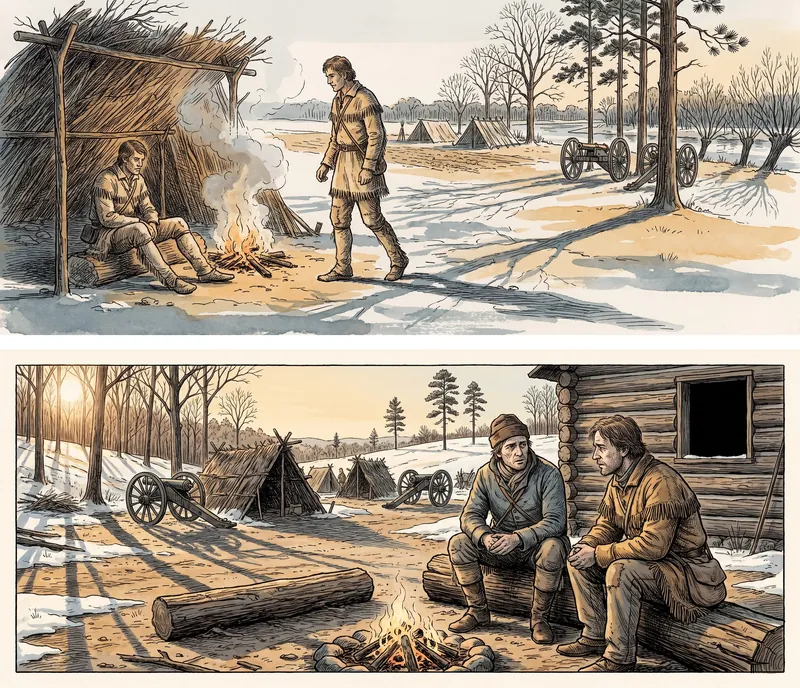
Run 50 · A good hypothesis, tested, and wrong
About half the frames come back inside a cream paper margin, at worst losing 16 per cent of the image. Likely culprit: the style description carried in every prompt says etched plate and hand-coloured plate, and a plate is a bordered page in a book.
Two images, two words different, prediction filed before spending. Above, the word kept: clean to all four edges. Below, the word removed: a 61-pixel border. Backwards. That is not exoneration, it is no evidence for — and worth buying, because the alternative was editing the style file every frame depends on, on a hunch.
2 images · 80 cr
hypothesis unsupported
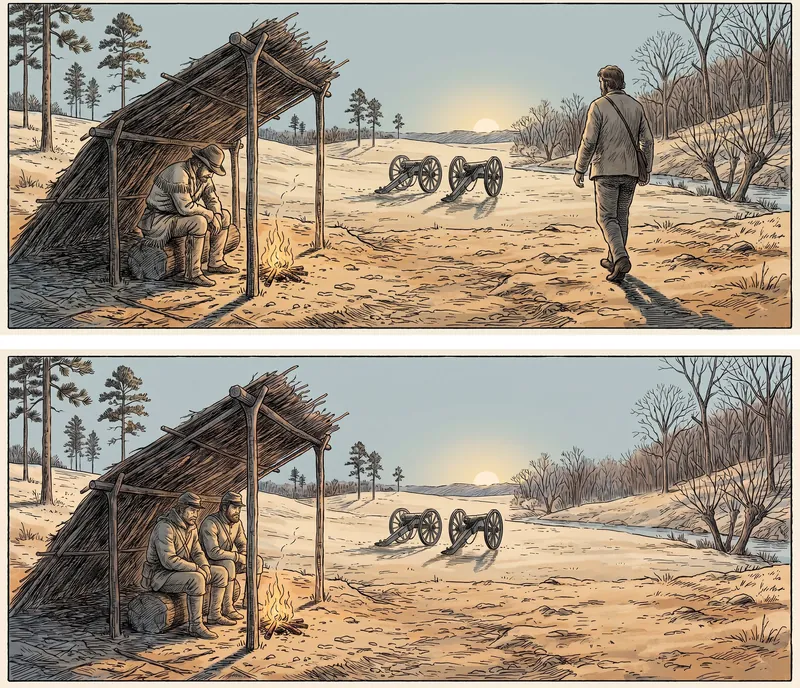
Run 49 · Edit the picture you have. Do not order a second one.
A moment needs a start frame and an end frame that match. Handing the model the reference plus the full scene description failed twice; that is not an edit request, it is “draw it all again, here is a picture.” A short instruction naming what stays and what moves measures 21.06 — as close as this model gets when you ask it to change nothing at all. Above the reference, below the edit.
Then Aaron looked at it and said the uniforms do not match. They do not: a soft peaked cap of the 1860s in a scene set in 1813. The number could not see it. It averages 4.3 million pixels and two men are a few per cent of them, so it was grading the set, not the pair. The keep-list named the shelter, the fire, the guns, the trees and the sun and got all of them right; for the clothing it said “the same clothes”, which names nothing.
1 image · 40 cr
pair still fails on wardrobe
Published because the defects are the more useful half. A programme that only reports its successes is producing marketing, not evidence.
- The walking man loses his hatHe wears a broad-brimmed felt hat at four seconds and is bare-headed by eight. The clip is not drifting. It is interpolating faithfully toward an end plate whose walking figure was already bare-headed, and that plate was generated from an action line that names no garment at all. Same shape as the wardrobe failure two runs earlier, and the same cause: the figure the instructions dress comes back dressed, and the figure introduced without garments gets whatever the model has lying around. The fix is one clause and one re-roll.
- The pair checker cannot see itThe tool that compares two plates reads the keep-and-change list of an edited plate and skips a generated one entirely, so the defect above was invisible to it and was caught by watching the clip. A check with a blind spot in it is worse than no check, because it reports clean.
- Two guns, then one, then twoThe gun count flickers across the eight seconds and the shelter’s near post shifts slightly. Recorded, not chased. Neither is a claim about the historical record, and both sit inside the drift this kind of model was already measured to produce.
- And no model ruling is being madeOne model, one beat, one clip. The alternative could not be run against it at a comparable setting inside the credit balance, and a cheap version of one model against an expensive version of another is two questions, not a comparison. What this proves is the pipeline, not the vendor.
None of this is the model getting better. It is the same model all week. What changes is how specific the requirement is, who checks it, and whether the check can see the thing it claims to be checking.
Every figure on this page is taken from the run records written at the time, each with its criteria set down before the images were paid for: RUN-46, RUN-49 and its wardrobe finding, RUN-50, and RUN-53, under 4-PRODUCTION/animation/. The clip is 11-S5_kling-v3_8s.mp4, 2208×936 at 24fps, re-encoded for the web here. The Creek War involved the mass killing of real people whose descendants are living communities today, the Poarch Band of Creek Indians and the Muscogee (Creek) Nation.